Filler vs Biostimulator
Two products sold for overlapping problems, priced in the same ballpark, and working in almost opposite ways. This is the comparison people get wrong most often, and the reason is that only one of them shows you anything on the day.
The mechanical difference
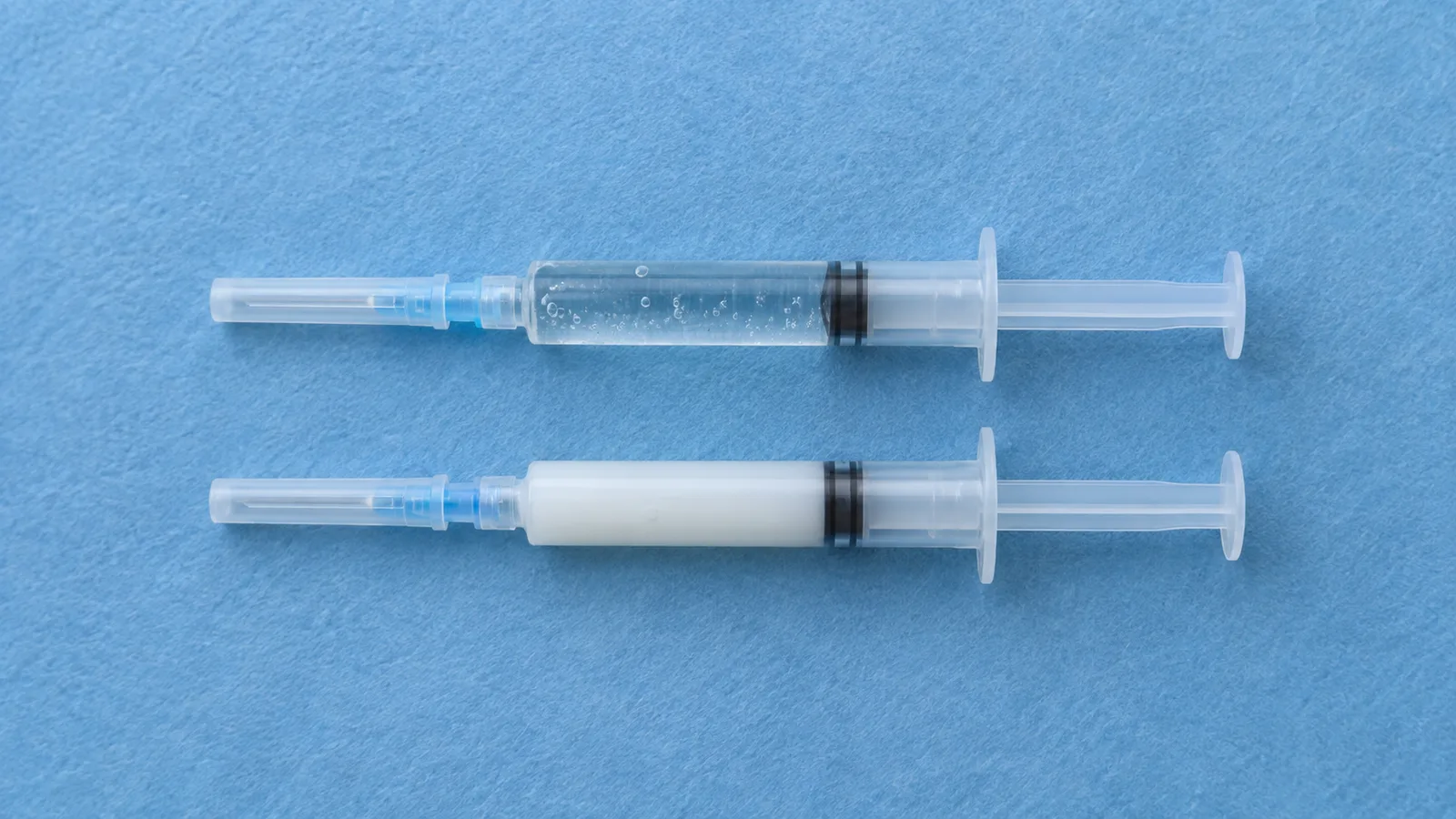
Dermal filler, in the form most people mean, is hyaluronic acid. It's a gel. It goes where it's placed and it occupies space, which is why the change is visible as soon as the swelling settles. You're buying volume, directly.
A biostimulator doesn't fill anything, or not for long. Products in this family, poly-L-lactic acid and calcium hydroxylapatite being the ones you'll hear named, act as a prompt. The material provokes your own tissue into producing collagen over the following weeks and months, and then the carrier itself is gradually absorbed. You're buying a process rather than a substance.
Everything else follows from that distinction.
Timing: instant versus slow
Filler is immediate. Some swelling, some settling over a week or two, and then what you see is what you have.
A biostimulator shows you almost nothing at first. There may be a temporary plumping from the injection volume that then disappears, which alarms people who weren't warned, and the actual result builds over a couple of months. It's usually a series of sessions spaced weeks apart, so the full picture can be a good part of a year away from your first appointment.
If you have a date in mind, this is the whole decision. A biostimulator started eight weeks before an event is not a plan. Filler at least operates on a timescale you can point at.
Reversibility, which is not the safety net people think
Hyaluronic acid filler can be dissolved with an enzyme, hyaluronidase. That's a real advantage and it's worth knowing about.
It's also less tidy than it sounds. Dissolving isn't precise to the millimetre, it can take more than one appointment, and it can affect tissue beyond exactly what you wanted removed. It's a correction, not an undo button, and anyone selling you filler on the basis that reversibility makes it consequence-free is overselling the enzyme.
Biostimulators are not reversible in the same way. What they prompt your body to build, your body keeps until it doesn't, on its own schedule. That's a genuine argument for going conservatively with a first treatment and for choosing an injector whose judgement you trust, rather than for avoiding the category.
How the money actually works out
This is where naive comparison falls apart.
Filler is usually priced per syringe, and the number of syringes for a given area is something an injector can estimate at the consultation. One appointment, one visible result, and a lifespan that runs anywhere from several months to something closer to two years, set mostly by the product chosen and the area treated.
Biostimulators are priced per vial or per session, and the plan is nearly always a series. So the entry price looks comparable and the committed total isn't. On the other side, the result once established tends to run on a longer horizon, and maintenance is less frequent. Before I'd enter a biostimulator total in any column, I'd read how the Hoboken practice Ethos lays out its own Sculptra course, including how the sessions are spaced.
Convert both to cost per month of effect over the full course, using conservative durations rather than the top of the range. Do it on paper. Sometimes the answer is that they're within a rounding error of each other, at which point the decision belongs to timing and reversibility rather than price, which is a much easier decision to make.
What to ask at the consultation
Ask what's actually being recommended for your face and why that family rather than the other. A good answer describes the problem first and the product second.
Ask how many sessions and over what period. Ask when you'd expect to see anything. Ask what the maintenance looks like at the end of the interval, and ask what the total is across the whole plan rather than the price of the appointment you're booking.
For filler, ask which product and what the plan would be if you didn't like it. For a biostimulator, ask what happens if the result is uneven, since the correction options are more limited and the practitioner should say so plainly.
Both are injectable, so both come with swelling and bruising as ordinary rather than unusual. Plan a clear week. Heat and strong sun tend to make early swelling worse, which is why I look at National Weather Service before choosing a date in summer rather than booking the first free slot.
Where to take these questions
Two consultations, both quoting the whole plan, both itemised. Compare the reasoning as much as the number, because in this pair the reasoning is what tells you whether someone is matching the product to your problem or matching it to their inventory.
Plenty of us already come down the hill regularly, for work or for study at places like Stevens Institute of Technology, which makes treating the lower half of the county as part of your shortlist entirely practical. For what's recently opened or changed hands around town, local coverage like Union City Patch - Local News, Events and Calendar is more current than any directory, though it can't tell you anything about how someone injects.
One nearby option to start from: a Hoboken practice, physician-led, that does dermal fillers. Ask them which biostimulators they carry, if any, and what they'd recommend for your particular problem, then take that answer somewhere else and ask again.
The honest summary
Choose filler when you want a visible change on a known timescale, in a defined area, with the option of correction if it isn't right.
Choose a biostimulator when the problem is more diffuse, when you're not working to a date, and when you're comfortable committing to a series before you see much of anything.
And if the recommendation you get doesn't mention your timeline at all, ask about it directly. It's the single biggest practical difference between the two, and it's the one most likely to go unmentioned in a room where everyone is looking at your face rather than your calendar.