Microneedling vs RF Microneedling
These are not the same treatment with a premium badge on one of them. They're two different things that happen to share a delivery mechanism, and the price gap between them is mostly honest.
Whether the gap is worth paying is a separate question, and it depends on what you're actually trying to fix.
What each one does
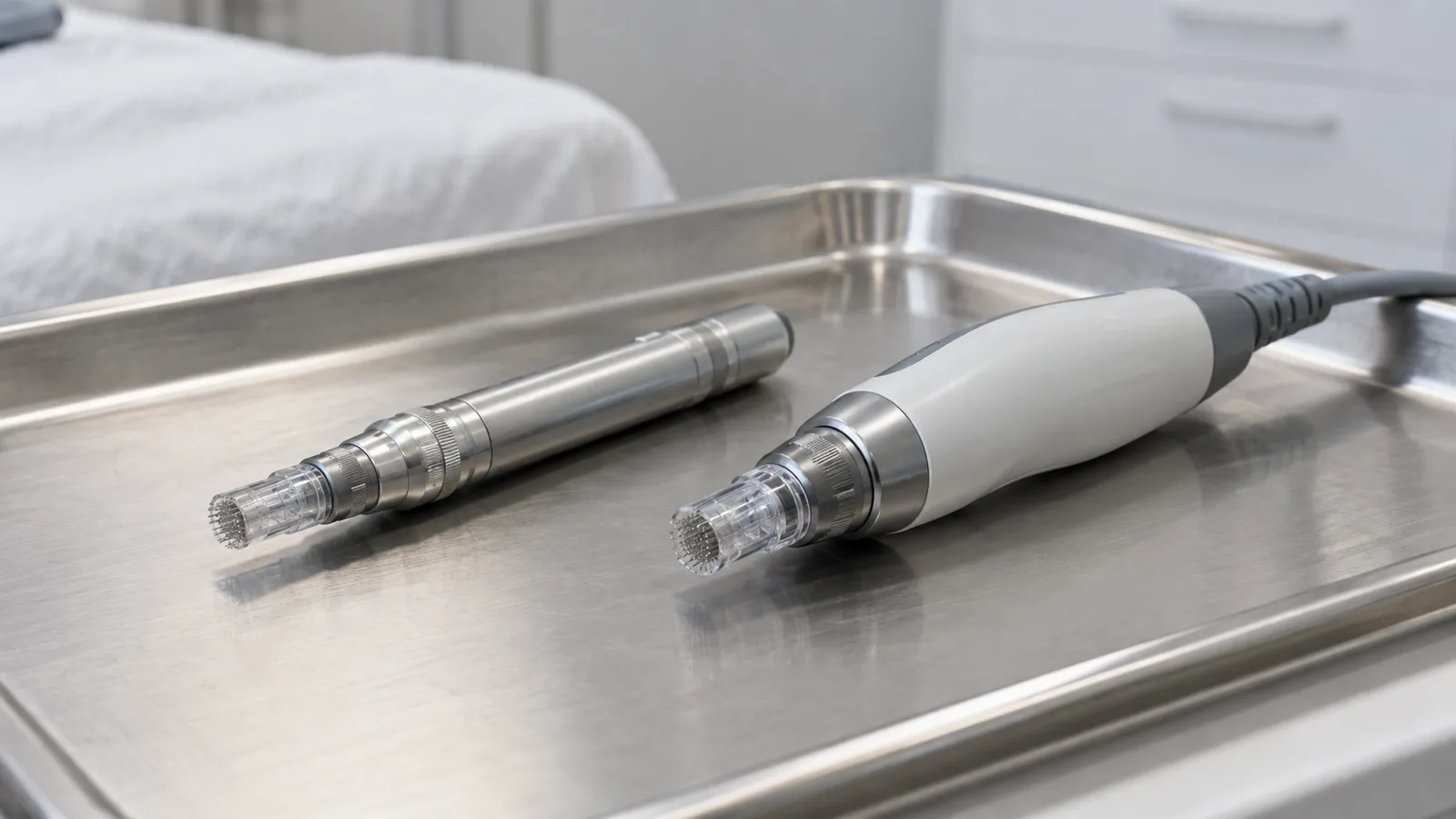
Standard microneedling uses fine needles to make controlled micro-injuries in the skin. The skin responds to injury by repairing, and the repair process lays down new collagen. That's the whole mechanism. It's mechanical, it works in the upper layers, and it's aimed at texture: fine lines, the surface irregularity left by acne scarring, general roughness.
RF microneedling does all of that and adds radiofrequency energy delivered through the needles themselves, usually insulated so the energy lands at a set depth rather than at the surface. The heat creates a second, thermal stimulus in the deeper layer, which is a different kind of prompt to remodel.
The short version: one is a mechanical signal, the other is mechanical plus thermal, delivered deeper. More is happening, so more is being charged.
When the upgrade earns its price
Broadly, the deeper thermal component is aimed at laxity and at deeper textural problems, where surface needling alone tends to under-deliver.
If what bothers you is mild surface texture and fine lines, standard needling is a reasonable place to start and you may never need the other one. If it's skin that's lost firmness, or scarring with real depth to it, the version with energy in it is the one being offered for a reason rather than as an upsell.
There's usually a session-count difference too. Standard needling is sold as a course of several; RF is often quoted as fewer sessions, which changes the arithmetic considerably once you total the full course rather than comparing single visits. Sometimes the expensive-sounding option is the cheaper course. Ask for both totals.
One more point that comes up a lot: because radiofrequency isn't light-based, it's often described as more suitable across a wider range of skin tones than some laser treatments. That's a real consideration and it's also exactly the kind of claim to put to a practitioner who can see your skin, rather than settling it from a webpage.
What the difference feels like
More energy means more sensation and more recovery.
Standard needling generally involves numbing, then redness afterwards that reads as a bad sunburn for a day or so, sometimes with light flaking after. Unpleasant but manageable, and most people are presentable quickly.
RF needling is more of an event. Longer numbing, more discomfort during, and swelling as well as redness afterwards, often with a small grid pattern visible on the skin for a few days. It settles, but it's a few days where you'd rather not have anything in the diary.
Neither is a lunchtime appointment, whatever anyone tells you. Both want a clear stretch afterwards, and the RF version wants more of one. If your year is organised around a school calendar, the term breaks published by Union City Public Schools are the obvious windows to aim for with the more demanding version.
Comparing the quotes properly
Same rule as everywhere else on this site: compare the course, not the session.
Get the total for the full recommended course of each, including any follow-up. Ask how many sessions and at what spacing. Ask how long the result is expected to hold before you'd be back for maintenance, and take the conservative end of the range you're given. Then divide the total by the months of effect.
Also ask which device. There's a wide range of equipment in this category and they aren't equivalent, particularly on needle depth and whether the needles are insulated. You don't need to become an expert on machines. You do need the name, because it's a question the practitioner should be comfortable answering and the answer tells you how they think about what they're doing.
And ask who operates it. Energy-based devices in particular are a licensing and training question, not a preference question, and you're entitled to a direct answer before the day.
Working out where to ask
Two consultations, both quoting the same area, both itemised over a full course. That's the comparison, and it's the only way to find out whether the premium in front of you is a real difference in the treatment plan or a difference in how two practices price the same thing.
Confirming that an operation is established and reachable is a separate and much narrower check, and member directories like the North Jersey Chamber of Commerce do that job. For what's newly opened or recently changed hands nearby, local coverage such as Union City, NJ News notices before any directory does. If your search widens out past the county, the statewide listings kept by the New Jersey Chamber of Commerce will show you what else is in range. None of those sources knows anything about clinical judgement and none of them should be doing the deciding.
If you want to ask these questions somewhere nearby, Ethos Aesthetics does microneedling in Hoboken, with a doctor overseeing the practice. Ask them whether they offer the RF version, which device they use and which version of the treatment they're quoting you, exactly as you'd ask anywhere else, and then put the answer next to the other quote you've collected.
So which one
If your problem is on the surface, start with standard needling and see where a complete course gets you. It's cheaper per session, gentler, and it may be enough.
If your problem has depth to it, and you've had the conversation with someone who examined your skin and said so, the RF version is the one built for that and paying for the lesser treatment to save money is the more expensive mistake.
What you shouldn't do is let the choice be made by which one was on offer the week you walked in.